What is Autism?
(Actually.)
Let's start here: everything you've probably heard about autism was built on a very narrow slice of who autistic people actually are. It was built on research about white boys, on behaviors visible enough to flag in a classroom, on a model that treated difference as deficiency. If that description doesn't match you or someone you love, that's not evidence you're not autistic. That's evidence the model was incomplete.
Here's what I actually know, after 20+ years of clinical work, a late diagnosis of my own, and a family tree that makes a whole lot more sense in retrospect.
The Official Definition (and Why It's Only Part of the Story)
The DSM-5 defines Autism Spectrum Disorder as a developmental condition characterized by differences in communication, social interaction, and interpersonal relationships alongside restricted or repetitive behaviors, patterns, or interests, a need for predictability, and a unique relationship with sensory environments.
A diagnosis requires that these traits cause clinically significant impact in daily life.
That's the clinical version. Here's what that actually looks like in practice: a nervous system that processes the world at a fundamentally different frequency. More sensory input, more thoughts (research suggests about 40% more neural connectivity than neurotypical brains), more pattern recognition, more intensity across the board. It's not a checklist of deficits. It's a neurotype, a kind of brain with its own logic, its own needs, and its own very particular way of moving through a world that wasn't designed for it.
The Language, Because It Matters
Words in this space change fast, and I know it's hard to keep up. Here's where things stand:
Neurodivergent is a non-medical term for people whose brains develop or work differently. It includes autism, ADHD, dyslexia, OCD, dyscalculia, dyspraxia, hyperlexia, synesthesia, and more.
Neurotypical is the term for people who are not neurodivergent.
Allistic means non-autistic specifically.
Neurodiverse refers to a group or community, not an individual. A person is neurodivergent. A community is neurodiverse.
"Autistic person" vs. "person with autism": Most autistic adults I work with prefer identity-first language — autistic person, because autism isn't incidental to who they are; it's woven through everything. I follow my clients' lead. If you have a preference, tell me.
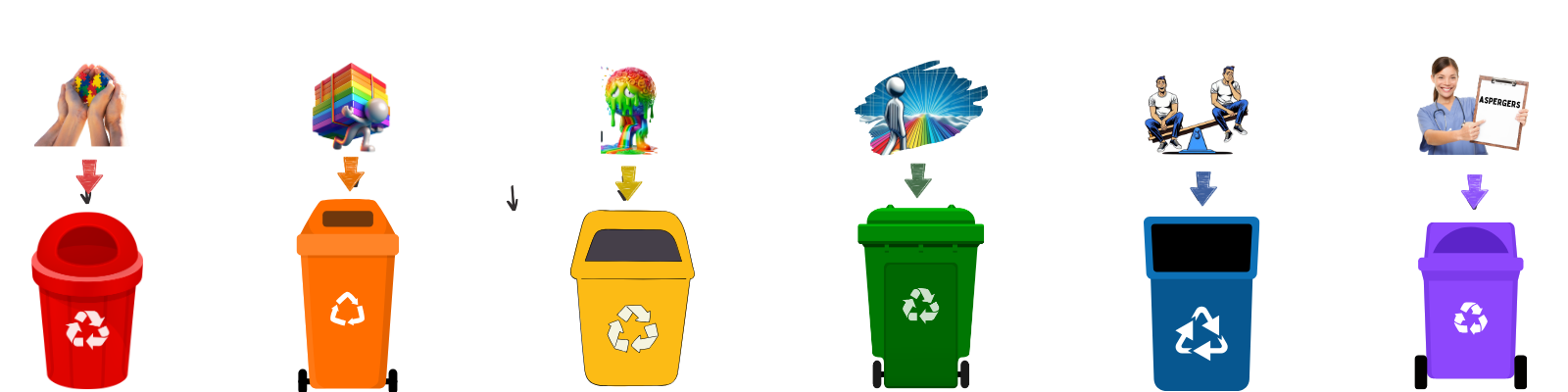
What we've gotten rid of: puzzle pieces (rejected by most of the community), "suffering from autism," and especially "high-functioning" and "low-functioning." Functioning labels attempt to assess someone's value based on their visible output in society essentially, how well they can mask. They minimize internal experience and do real harm. We're not using them here.
Asperger's was removed from the DSM in 2013. What used to be called Asperger's Disorder, Autistic Disorder, and PDD-NOS are now all under the umbrella of Autism Spectrum Disorder.
Two Models. One Clearly Better.
The medical model looks at autism through a lens of deficits…what's "wrong," what needs to be fixed, what behaviors should be eliminated even when they're not hurting anyone. It's why stimming gets discouraged. Why eye contact gets forced. Why a generation of autistic people grew up in ABA programs that prioritized looking neurotypical over actually feeling okay. This practice does not operate from the medical model.
The social model asks a different question: not what's wrong with this person, but what does this person need, and how can the world make more room for them? It starts from acceptance of the autistic experience as legitimate. It centers accommodation over correction. That's the model we work from.
Why You Might Not Have Been Diagnosed Sooner
The average autistic adult I work with has been misdiagnosed eight times before getting an accurate diagnosis. Eight. My outliers have seen twelve providers. That's not because autism is rare or subtle, it's because our diagnostic frameworks were built for a specific kind of autism that doesn't describe most of my caseload.
The research was built on children. On boys. On visible, stereotypical presentations. Women, gender-diverse people, adults, high-maskers, anyone outside that original narrow slice -- we were getting missed. Or worse, we were getting labeled with something else: anxiety, depression, bipolar disorder, borderline personality disorder, OCD, PTSD, narcissistic personality disorder. Some of those co-occur with autism. But when they're treated as the whole story and the autism underneath goes unseen, the treatments often don't work because they're addressing the symptom, not the source.
There's no villain in this story. Most of the providers who missed it were doing their best with incomplete information. But the impact is real: provider trauma, accumulated from years of being failed by systems that were supposed to help, is one of the most common things I see walk through my door.
On Masking
Masking is the process of learning to suppress, hide, or camouflage autistic traits to fit into neurotypical spaces. Most of my clients are expert-level maskers. They've been doing it since childhood, often without knowing that's what they were doing. They memorized social scripts. Suppressed the behaviors that regulated their nervous systems. Learned to perform eye contact that felt like sandpaper and call it connection.
Masking works, in the sense that it keeps people safe and functional. It also costs an enormous amount. The autistic people in my office aren't suffering because of their autism. They're suffering because of what it takes to hide it in a world that wasn't built for them.
This is why standard assessments often miss high-masking adults. If you walk into an evaluation performing the neurotypical version of yourself that you've spent thirty years perfecting, the test is measuring the performance, not the person underneath it.
Autism and Trauma: They're Not the Same Thing, But They're Not Separate Either
Here's something our field hasn't fully grappled with yet: there has never been a generation of autistic people who grew up fully seen, accurately diagnosed, genuinely accommodated, and believed. Not one.
Every autistic adult in clinical settings today grew up in a world that, at best, didn't know what to do with them. The behaviors that were adaptive…the stimming, the need for routine, the honest and direct communication were treated as problems. The sensitivity that made them human was labeled as too much. And the trauma of that, accumulated over decades, looks a lot like the autism itself when you don't know what you're looking at.
I say this as someone who sat in a decade of therapy, doing genuine work with genuinely skilled providers, while my autism was in the room for every single session. It was in the monologuing. The inability to find a stopping point. The way I could describe my emotional experience in clinical detail but couldn't locate it in my body. Nobody saw it. And the treatments I was given for the things they did see anxiety, depression, borderline, bipolar, take your pick, didn't work the way they were supposed to, because they were treating the adaptation rather than the origin.
Autism doesn't cause trauma. But living as an undiagnosed autistic person in a world built for someone else almost always does.
Getting a Diagnosis
An autism assessment can be pursued with a number of professionals. Self-diagnosis is welcomed and acknowledged in this practice. If you've done significant research, if you've found your experience described in autistic community spaces, if you've spent years feeling like you were running an exhausting performance of someone you're not, that is data. It counts.
Formal diagnostic services in my practice are available for adolescents through adults. If you've been evaluated before and told you don't meet criteria, it's worth knowing that most standardized assessment tools were designed for a different presentation than yours. Narrative assessments, the kind that take time, ask the right questions, and actually get to know you…tell a fuller story.
Social media, for all its bad press, has also been a genuine pathway for many people, the algorithm serves up content that finally matches their experience, and that match is often the first time they think: wait. That's me.
Which, not coincidentally, is also the name of my podcast. Come find us.